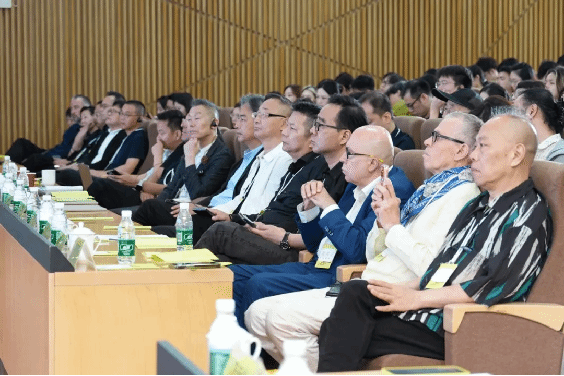
7月5日,由广州美术学院主办,绘画艺术学院承办,国际交流合作部、艺术与人文学院、艺术与科技实验室、东莞理工学院国际设计学院协办的2026年造型艺术与科技媒介国际教育研讨会,于昌岗校区设计大楼二楼国际学术会议报告厅举行。来自法国、意大利、日本、奥地利、乌克兰及国内多所知名艺术院校的院长、教授、国际策展人与前沿实验艺术家齐聚一堂,围绕“当代艺术教育与科技”“艺术策展与科技”“艺术视野与生态共域”“媒介材料与数字艺术”四大核心议题展开深度对话。研讨会设主旨演讲、圆桌论坛等环节,二十余位专家学者从多维角度切入,系统比较不同文化背景与教育体系下科技媒介融入造型艺术教学的理念、方法与实操路径。
On July 5th, the 2026 International Symposium on Plastic Arts and Technological Media in Education , hosted by the Guangzhou Academy of Fine Arts, organized by the School of Painting and Drawing, and co-organized by the Foreign Affairs Office, the School of Arts and Humanities, the Art and Technology Laboratory, and the International School of Design of Dongguan University of Technology, was held in the International Academic Conference Hall on the second floor of the Design Building on the Changgang Campus. Deans, professors, international curators, and cutting-edge experimental artists from renowned art institutions in France, Italy, Japan, Austria, Ukraine, and China gathered to engage in in-depth dialogues on four core topics: "Contemporary Art Education and Technology," "Art Curation and Technology," "Artistic Vision and Ecological Coexistence," and "Media Materials and Digital Art ." The symposium included keynote speeches and roundtable discussions, with over twenty experts and scholars offering multi-dimensional perspectives and systematically comparing the concepts, methods, and practical approaches of integrating technological media into plastic arts teaching across different cultural backgrounds and educational systems.
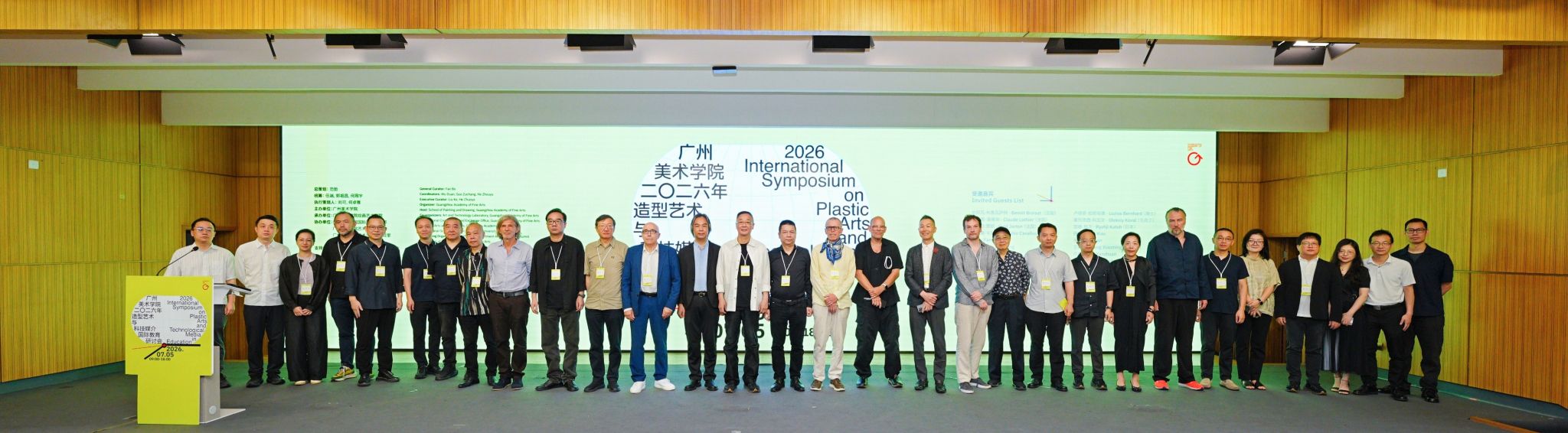
嘉宾合影
Group photo
论坛启幕
Opening Ceremony
09:00–09:20|昌岗校区国际学术会议报告厅
09:00–09:20|International Academic Conference Hall, Changgang Campus
1
议题一:当代艺术教育与科技
Session 1: Contemporary Art Education and Technology
09:20–10:20|昌岗校区国际学术会议报告厅
09:20–10:20|International Academic Conference Hall, Changgang Campus
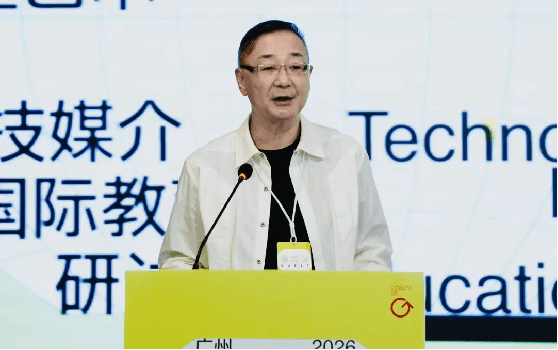
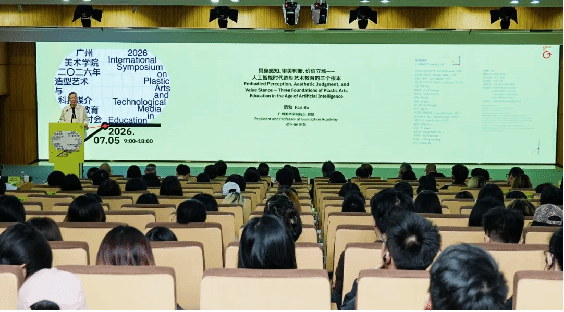
范勃教授首先代表学校对远道而来的嘉宾表示欢迎,并以《具身感知、审美判断、价值立场——人工智能时代造型艺术教育的三个根本》为题作主旨发言。他提出,今天,生成式人工智能再一次把我们推回原点:艺术从来不是技艺的展示,而是人认识自身、感知世界、确立立场的方式。具身感知、审美判断、价值立场,这三个根本直指问题核心,它们共同构成造型艺术教育在人工智能时代不可让渡的内核。他的发言不仅为全天研讨奠定了基调,也引发了与会者的持续共鸣,成为整场论坛贯穿始终的核心学术共识。
Professor Fan Bo first welcomed the guests on behalf of GAFA and delivered a keynote speech entitled "Embodied Perception, Aesthetic Judgment, and Value Stance: Three Foundations of Plastic Arts Education in the Age of Artificial Intelligence." He pointed out that today, generative artificial intelligence has once again pushed us back to the starting point: art has never been a display of skill, but rather a way for people to understand themselves, perceive the world, and establish their stance. Embodied perception, aesthetic judgment, and value stance—these three foundations directly address the core issue, and together they constitute the inviolable core of plastic arts education in the age of artificial intelligence. His speech not only set the tone for the entire day's discussion but also resonated with the participants, becoming the core academic consensus that ran throughout the forum.
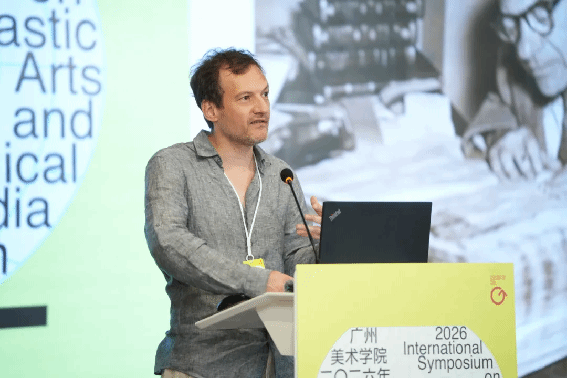
伯努瓦·布鲁瓦萨特教授以《作为符号形式的数字》为题,指出数字技术不仅是一种工具,更是一种象征形式,深刻改变了人与世界的关系。他通过对数字符号生成逻辑的剖析,揭示了人工智能时代视觉创作底层语言的新变化。
In his presentation titled "The Digital as a Symbolic Form," Professor Benoit Broisat argued that digital technology is not merely a tool, but also a symbolic form that has profoundly altered the relationship between humanity and the world. Through an analysis of the logic behind the generation of digital symbols, he revealed new changes in the underlying language of visual creation in the age of artificial intelligence.
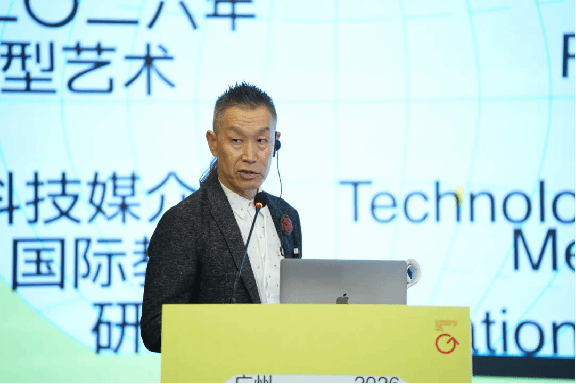
加藤・良次教授在《横滨美术大学的艺术教育与数字技术》的主题演讲中分享了横滨美术大学从小学到大学贯通式的信息教育体系建构经验,介绍了学校在传统工艺教学中系统融入数字设计工具的做法,展示了如何在平衡手工本体与数字创作的基础上培养未来型人才。
In his keynote speech, "Art Education and Digital Technology at Yokohama University of Arts & Design," Professor Ryoji Kato shared Yokohama University of Arts & Design's experience in building an integrated information education system from elementary school to university. He introduced the school's practice of systematically integrating digital design tools into traditional craft teaching and demonstrated how to cultivate future talents while balancing handicrafts and digital creation.
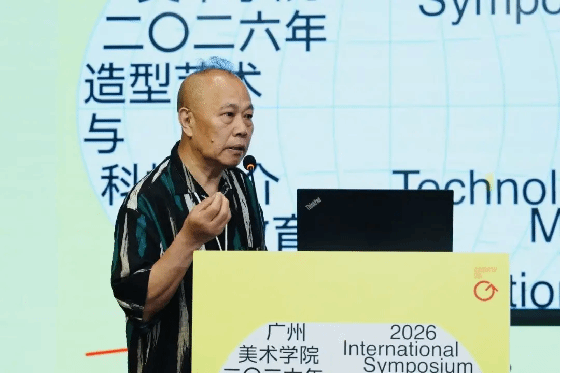
管怀宾教授带来题为《融超经验——跨媒体艺术之路》的主题分享,以跨媒体学院的发展历程为例,展现了艺术教育在跨专业、跨学科、跨领域方面的探索实践。他从“融超经验”的角度出发,梳理了跨媒体艺术教育如何通过动态的知识系统回应技术迭代带来的挑战。
Professor Guan Huaibin delivered a keynote speech entitled "Trans-experiential: The Path of Intermedia Art," using the development history of the School of Transmedia Arts as an example to showcase the exploration and practice of art education in interdisciplinary, and inter-field aspects. From the perspective of "integrating beyond experience," he outlined how transmedia art education responds to the challenges brought about by technological iteration through a dynamic knowledge system.
2
议题二:艺术策展与科技
Session 2: Art Curation and Technology
10:20–11:20|昌岗校区国际学术会议报告厅
10:20–11:20|International Academic Conference Hall, Changgang Campus
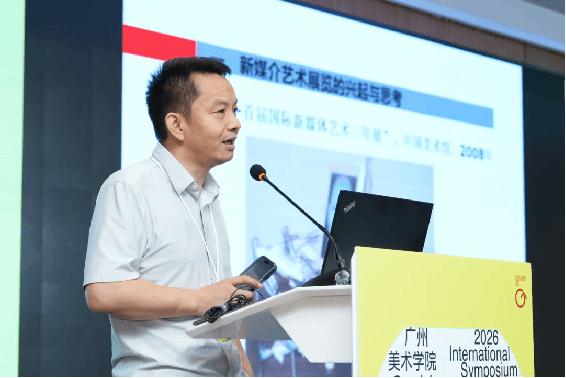
胡斌教授以《数字技术时代中国青年艺术家的新媒介实践与反思》为题,梳理了数字媒介下中国青年艺术家创作的新特征。他从自身策展实践出发,对数字时代艺术主体性问题提出了深刻思考,指出在新媒介环境中,创作与推介已融为一体。
Professor Hu Bin, in his presentation titled "New Media Practices and Reflections of Young Chinese Artists in the Era of Digital Technology," outlined the new characteristics of young Chinese artists' creations under the digital media landscape. Drawing from his own curatorial practice, he offered profound insights into the issue of artistic subjectivity in the digital age, pointing out that creation and promotion have become integrated in the new media environment.
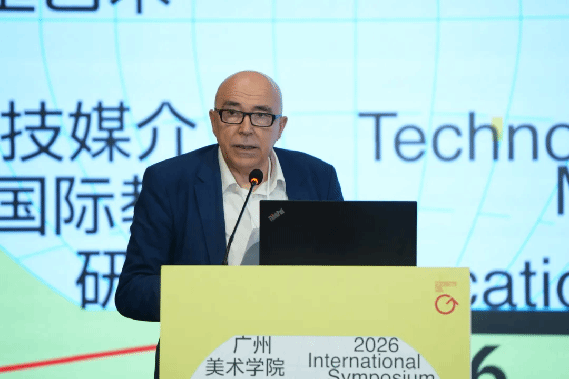
法比奥·卡瓦卢奇教授以《数字策展:以Institution为案例》为题,从拿破仑时代博物馆制度的起源谈起,绘制了一幅当代数字展览的动态地图。他提出,未来策展人的使命不再是自上而下地建立秩序,而是引导人们在不断扩容的信息海洋中找到属于自己的路径。
Professor Fabio Cavallucci, in his presentation titled "Digital Curating: The Case of Institution," began by discussing the origins of the museum system during the Napoleonic era and drew a dynamic map of contemporary digital exhibitions. He proposed that the mission of future curators will no longer be to establish order from the top down, but rather to guide people to find their own paths in the ever-expanding ocean of information.
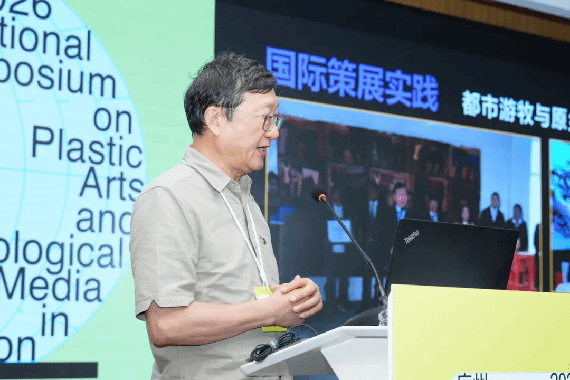
顾振清先生结合自身在全球的策展经验,强调“去中心化”是数字化时代艺术对抗技术焦虑的重要方式。他以自身从中国策展人转向国际策展人的实践为例,提出物理中心化与数字去中心化并行的策展新思路。
Drawing on his global curatorial experience, Mr. Gu Zhenqing emphasized that "decentralization" is a crucial way for art to combat technological anxiety in the digital age. Using his own experience transitioning from a Chinese curator to an international curator as an example, he proposed a new curatorial approach that combines physical centralization with digital decentralization.
3
议题三:艺术视野与生态共域
Session 3: Artistic Vision and Ecological Coexistence
14:00–15:00|昌岗校区国际学术会议报告厅
14:00–15:00|International Academic Conference Hall, Changgang Campus
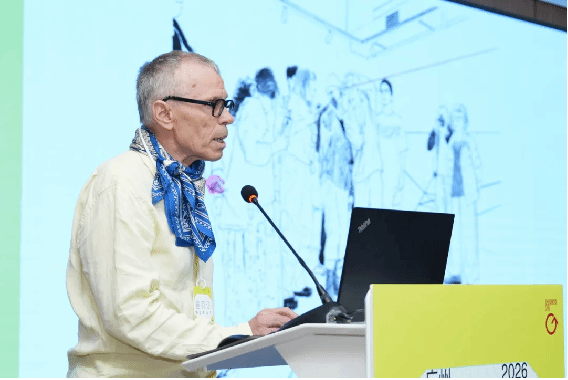
克劳德·洛蒂埃教授以《数字与虚拟空间透视》为题,从传统透视理论的底层逻辑出发,剖析了虚拟数字空间中视觉构建的全新可能性。他强调,透视法并非割裂人与世界的工具,而是一种可以调动身体感知的普适性认知体系。
Professor Claude Lothier, in his presentation titled "Perspective in Digital and Virtual Spaces," started from the underlying logic of traditional perspective theory and analyzed the new possibilities of visual construction in virtual digital spaces. He emphasized that perspective is not a tool that separates people from the world, but rather a universal cognitive system that can mobilize bodily perception.
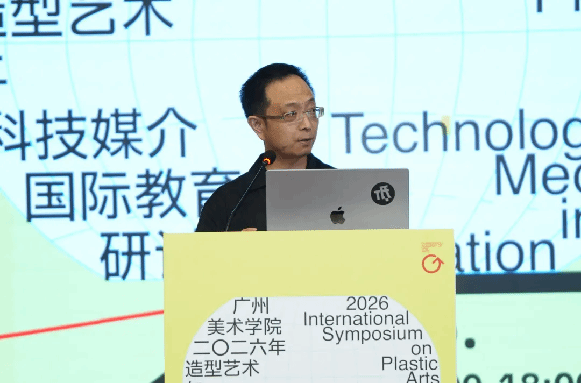
郑达教授以《智能体为导向的艺术实践》为题,分享了以智能体创作为核心的艺术实践与教学探索。他提出“AI生成的结果不是答案,而是需要被验证的假设”,强调艺术家应先去掌握技术、再去批判它。
Professor Zheng Da, in his presentation titled "Agent-Oriented Artistic Practice," shared his artistic practices and teaching explorations centered on intelligent agent creation. He proposed that "the results generated by AI are not answers, but hypotheses that need to be verified," emphasizing that artists should first master the technology before critiquing it.
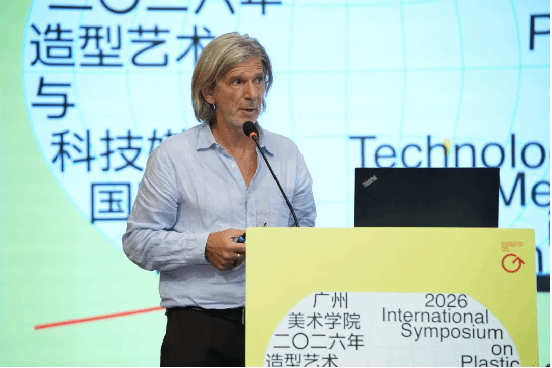
希里尔·贾顿教授分享了数字工具在工业遗产修复及艺术与生态功能重塑中的应用。他通过中法两地的在地艺术改造项目,展示了如何运用热成像、感温变色材料等数字工具,让废弃工业遗址焕发新的生态与艺术价值。
Professor Cyril Jardon shared insights into the application of digital tools in the restoration of industrial heritage and the reshaping of its artistic and ecological functions. Through local art transformation projects in China and France, he demonstrated how digital tools such as thermal imaging and thermochromic materials can revitalize abandoned industrial sites and give them new ecological and artistic value.
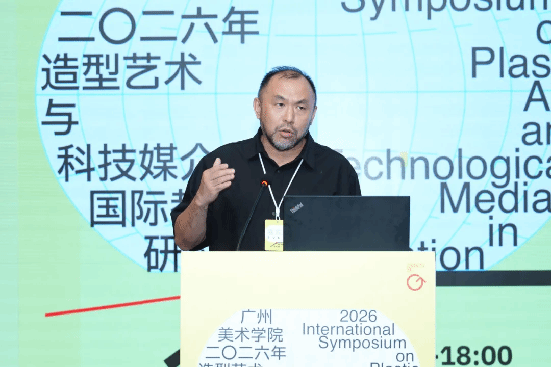
刘可教授提出“国际共域的教学路径”理念,系统介绍了油画系以“课程即项目、项目即课程”为核心的国际化教学体系建设经验。他阐释了油画系通过分布式可持续的艺术空间与机构合作,构建艺术家生产机制生态的实践路径。
Professor Liu Ke proposed the concept of an "internationally shared teaching approach" and systematically introduced the Oil Painting Department's experience in building an international teaching system centered on "courses as projects and projects as courses." He explained the Oil Painting Department's practical approach of constructing an ecosystem for artist production mechanisms through distributed and sustainable art spaces and institutional collaborations.
4
议题四:媒介材料与数字艺术
Session 4: Media Materials and Digital Art
15:00–16:00|昌岗校区国际学术会议报告厅
15:00–16:00|International Academic Conference Hall, Changgang Campus
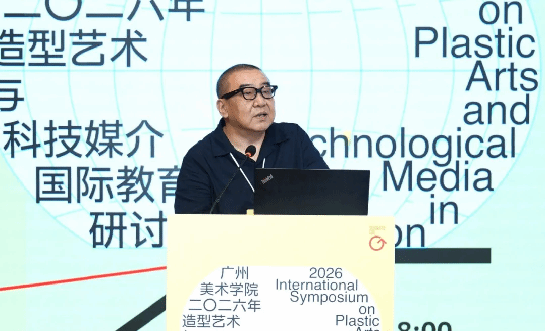
唐骁教授以《没有矛盾就没有世界》为题,提出在技术理性全面接管感知的时代,矛盾是艺术创作最重要的认识论装置。他以自己在盒子美术馆的个展为例,展示了如何在航海信号旗、色彩理论等符号系统中制造错位与张力,让感知从沉睡中惊醒。
Professor Tang Xiao, in his presentation titled "No Contradiction, No World" argued that in an era where technological rationality has completely taken over perception, contradiction is the most important epistemological device for artistic creation. Using his solo exhibition at the Box Art Museum as an example, he demonstrated how to create dislocation and tension within symbolic systems such as nautical signal flags and color theory, thus awakening perception from its slumber.
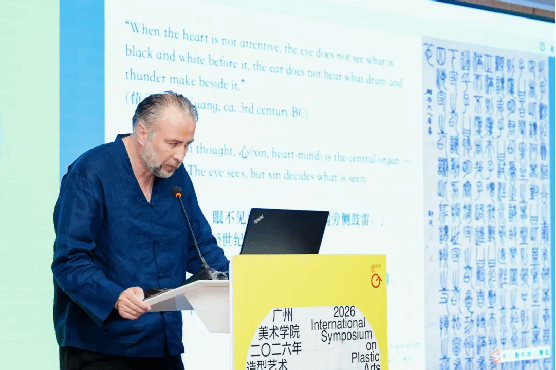
奥列克西·科瓦尔教授以神经科学与预测编码理论为基础,重新诠释了传统绘画的核心——节奏。他指出,绘画之所以“不自然”却必要,是因为它能够保持预测误差的开放,将这种误差传递给观众,从而产生最强的多巴胺触发。
Professor Oleksiy Koval, drawing on neuroscience and predictive coding theory, reinterprets the core of traditional painting—rhythm. He points out that painting is "unnatural" yet necessary because it keeps the predictive error open, transmitting this error to the viewer and thus generating the strongest dopamine trigger.
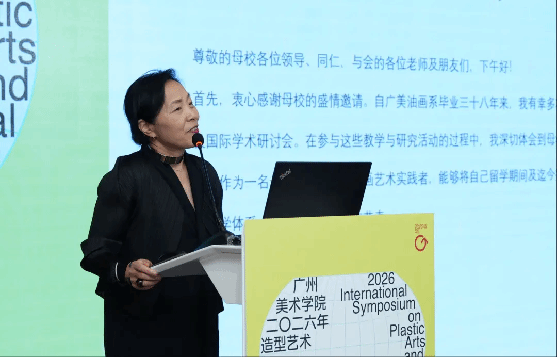
王晓鸣女士以《艺术创作材料与科技》为题,探讨了材料与科技相结合的创作路径。她分享了运用VR技术实现跨媒介表达的实践经验,通过将古典音乐转化为视觉作品,让观者从被动“观赏”转变为主动“沉浸”。
Ms. Wang Xiaoming, in her presentation titled "Art Creation Materials and Technology," explored creative paths that combine materials and technology. She shared her practical experience in using VR technology to achieve cross-media expression, transforming classical music into visual works that allow viewers to shift from passively "watching" to actively "immersing" in the experience.
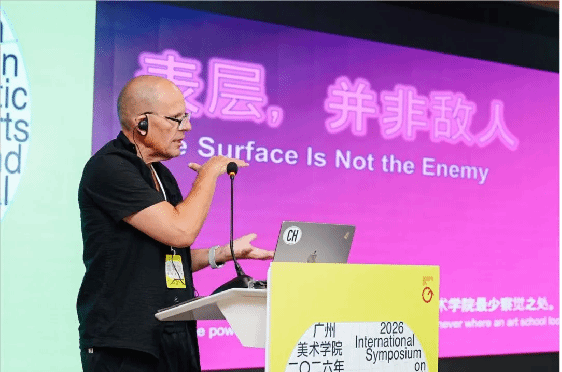
卢修斯·伯恩哈德教授提出“实验室即艺术基础设施”的教学理念。他强调,艺术教育的重点不在于教学生使用什么工具,而在于帮他们建立起一种“前实验性”的条件和环境——在没有人知道结果会怎样的状态下进行探索。
Professor Luzius Bernhard proposed the teaching concept of "the laboratory as the infrastructure of art." He emphasized that the focus of art education is not on teaching students what tools to use, but on helping them establish a "pre-experimental" condition and environment—exploring in a state where no one knows what the outcome will be.
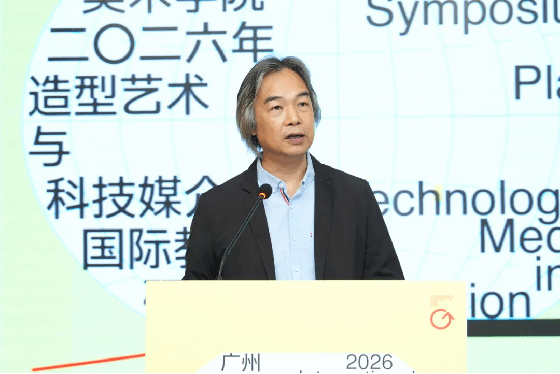
广州美术学院副院长蔡拥华主持大会开幕式
Cai Yonghua, Vice President of Guangzhou Academy of Fine Arts, presided over the opening ceremony of the conference.
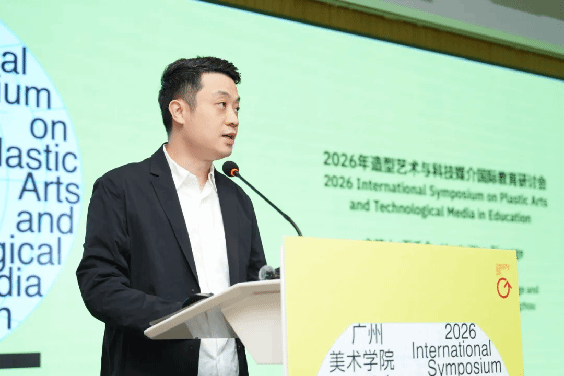
广州美术学院国际合作交流部副部长万千个主持学术会议
Wan Qiange, Deputy Director of the Foreign Affairs Office of GAFA, presided over the academic conference.
5
圆桌论坛
Roundtable Forum
昌岗校区国际学术会议报告厅
International Academic Conference Hall, Changgang Campus
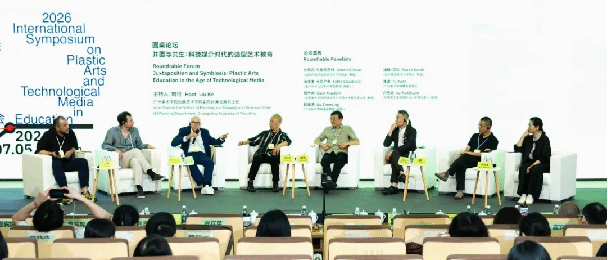
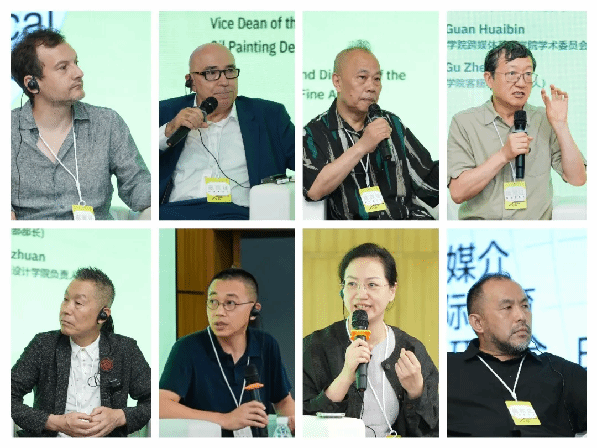
上午场圆桌论坛
Morning roundtable forum
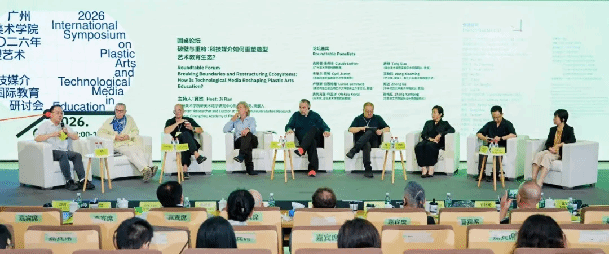
下午场圆桌论坛
Afternoon roundtable forum
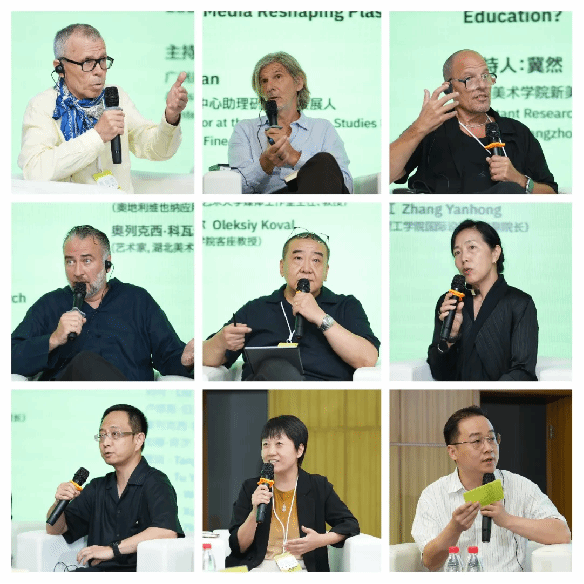
本次研讨会还设有上下午两场圆桌对谈,分别由刘可、冀然主持。论坛以《并置与共生:科技媒介时代的造型艺术教育》和《破壁与重构:科技媒介如何重塑造型艺术教育生态?》为主题,从并置、共生到重塑,议题设置本身揭示了艺术教育在数智时代面临的挑战与迎来的机遇。参与对谈的嘉宾结合各自的教学、创作与策展实践,展开了多维度的思想碰撞。
The symposium also included two roundtable discussions, one in the morning and one in the afternoon, moderated by Liu Ke and Ji Ran respectively. The forum, themed "Juxtaposition and Symbiosis: Art Education in the Age of Technological Media" and "Breaking Down Barriers and Reconstructing: How Technological Media Reshapes the Ecosystem of Art Education?", explored the themes of juxtaposition, symbiosis, and reconstruction, revealing the challenges and opportunities facing art education in the digital age. The participating guests engaged in multi-dimensional intellectual exchanges, drawing on their teaching, creative, and curatorial practices.
6
闭幕致辞
Closing Speech
17:30–17:50|昌岗校区国际学术会议报告厅
17:30–17:50|International Academic Conference Hall, Changgang Campus
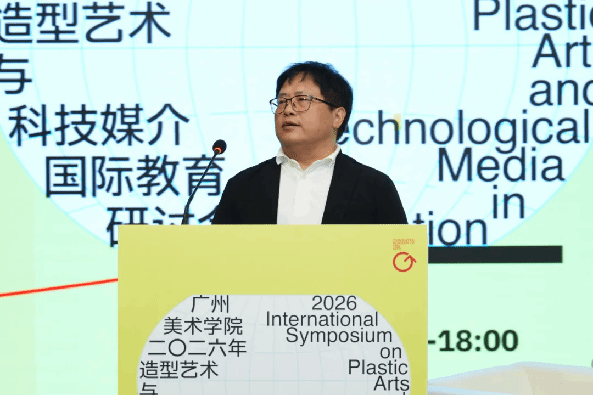
郭祖昌教授最后进行闭幕致辞。他表示,在四个议题单元的主旨发言及两场圆桌论坛中,来自不同文化背景、不同教育体系的嘉宾各抒己见,交锋融合:既有对人工智能冲击下传统造型学科核心价值的坚守与重申,也有对数字技术介入艺术创作、策展、教学全链条的创新路径分享,更有对艺术与生态、科技与人文关系的深层叩问。科技媒介对造型艺术及艺术教育的重塑不是简单的工具升级,而是认识论层面的重构。
Professor Guo Zuchang delivered the closing speech. He stated that in the keynote speeches of the four thematic sessions and the two roundtable forums, guests from different cultural backgrounds and educational systems shared their insights, engaging in lively debate and exchange. These included reaffirmations and upholding of the core values of traditional art disciplines in the face of the impact of artificial intelligence, sharing innovative pathways for digital technology to intervene in the entire chain of artistic creation, curation, and teaching, and profound inquiries into the relationship between art and ecology, and technology and humanities. The reshaping of art and art education by technological media is not simply a tool upgrade, but a reconstruction at the epistemological level.
本次2026年造型艺术与科技媒介国际教育研讨会立足数智时代美育核心命题,不仅搭建了跨国界、跨领域的学术对话桥梁,更凝聚了数智时代造型艺术教育坚守人文本体、拥抱技术变革的核心共识,为国内外艺术院校探索科技与艺术深度融合的教学模式提供了多元参照与创新启发。未来,绘画艺术学院将持续深化造型艺术学科的跨学科转型与国际化建设,推动科技媒介与造型艺术教育的共生发展,为培养兼具人文素养、创新能力与全球视野的新时代艺术人才持续探索,为中国当代美育的创新发展贡献广美力量。
The 2026 International Symposium on Plastic Arts and Technological Media in Education, grounded in the core themes of art education in the digital age, not only built bridges for cross-border and cross-disciplinary academic dialogue but also forged a core consensus on upholding the humanistic essence and embracing technological change in fine arts education in the digital age. It provided diverse references and innovative inspiration for art colleges both domestically and internationally to explore teaching models that deeply integrate technology and art. In the future, the School of Painting and Drawing will continue to deepen the interdisciplinary transformation and internationalization of fine arts, promote the symbiotic development of technological media and fine arts education, continuously explore ways to cultivate new-era art talents with humanistic qualities, innovative abilities, and a global perspective, and contribute the strength of the Guangzhou Academy of Fine Arts to the innovative development of contemporary Chinese art education.
